- Scholarly sources (2)
Newton, Julianne Hickerson. The Burden of Visual Truth : The Role of Photojournalism in Mediating Reality. Routledge, 2001. EBSCOhost
Even if this source talks about photojournalism which does not directly relate to my program (Cinema and Communications) it is still a part of the visual communications. This source is an electronic book, and I focused on Chapter 7 Is Seeing Still Believing. I gained a new perspective on my topic by learning about psychological and cultural aspects of simply looking at things. This line particularly captured my attention; « […]life is like looking into a rearview mirror. We never fully understand where we’ve been until we are beyond where we were and can contemplate what happened […] »Reading this source not only gave me content to include in my feature story, but also inspired me to find a similar line during the interview process.
Lee, Hye-ryeon. Media Credibility and the Spiral of Silence. Aug. 1989. EBSCOhost
This source explains a communication researcher’s theory called the Spiral of Silence which is about how people form their opinions while being exposed to mass media. It examines how one’s perception and opinion is influenced and predicted by mass media. I learned about a concrete theory where I can make a connection with elements of my on-topic sources. This theory also fits with my targeted audience which are people that are exposed to mass information on screens. The public opinion process is impacted by the content that we see. I also learned that this type of content can reinforce someone’s point-of-view on a situation or issue by provinding words and phrases to help them defend their opinion which I had never really thought about.
- Non-scholarly sources (2)
“5 Psychology Studies Show How People Perceive Visual Information.” Piktochart, 10 Nov. 2019.
Text on visual information processing
This source talks about 5 different ways in which we perceive information visually. Once again, I learned about a concrete concept that has a connection with my on-topic sources. I was exposed to new perspectives regarding visual information processing. This source informed me about how we interpret what we see; I learned that simple elements like the font and the colors chosen can affect the viewers’ perception. According to one of the theories, we make assumptions based on beliefs, prior knowledge and expectations when looking at an image. This made me realize that there are way more aspects of visual communication to explore that I had never thought about before starting the research journey.
Vijay, Digital. “Why Visual Communication Is So Important in Content Marketing.” Medium, Marketing And Growth Hacking, 21 Nov. 2019.
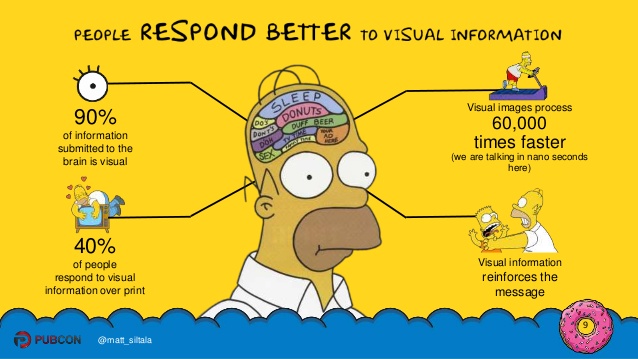
This source also talks about visual information, but more precisely how it communicates with people because it is a way to understand what is being portrayed very easily. I changed my view on another component of my topic by learning tools that are used in marketing content which relates to some awareness campaigns. I learned that videos and images are most likely to have a bigger impact on the viewer than text. Visually representing content also helps with the retention of the information. That explains why the anti-seal hunt activists and organizations use images for their campaigns as well as Bell who promote their mental health campaign with several short videos.
Cultural artifact
Experiential research
For my experiential research, I reflected on my topic and decided to observe what I see on screens and posters throughout my daily routine. I realized that there is an immense amount of information to process, and it can be very overwhelming. For example, taking the metro can be visually exhausting if we pay close attention to all the images surrounding us. From the advertisement posters in the wagons to the news on the screens, there is information everywhere! I began thinking that maybe this is the reason why everyone is so tired at the end of the day; not because of going to school or work, but maybe because subconsciously processing all of this visual information is simply too much. This visual content that we see daily must have an impact on the way in which we perceive things, and somehow succeeds in shaping some of our opinions.
Librarian visit
I went to my local library (Bibliothèque L’Octogone) and I spoke to Andrea Winiarz. I quickly explained my feature story’s topic to her, and she said that the most related documentation to my topic that they had was about marketing. She referred me to three books, and I picked two of them. After briefly looking at them, the one that is closer to what I want to talk about is in French and explores the dangerous efficiency of marketing. On some level, I feel like it can connect with awareness campaigns; however, I don’t think that I will be using this book as a source for my feature story, but maybe to consult sometimes to give me other ideas about my topic.
Here are the two books that I picked from my visit :
Wershler-Henry, Darren S., and Mark Surman. Commonspace: beyond Virtual Community: Seize the Power of the Collective. FT.com, Pearson Education Canada, 2001.
Nantel, Jacques, and Ariane Krol. On Veut Votre Bien Et on L’aura:Éditions Transcontinental, 2011.
 Alexandra's Nonfiction Writing Blog